Updates automatically as you type.
Calculated in your browser; your inputs are not sent to us. Privacy
Calculation details
Review the generated output before relying on it.
This tool runs in your browser. Your calculator inputs and results are never transmitted to us or to ad/affiliate partners. Ads and sponsored links may set third-party cookies to serve and measure them, but they never receive your calculation values. If you explicitly save a scenario, its permitted fields stay in local browser storage until you clear them. See our Privacy Policy.
Use this result
Share the current inputs or ask ChatGPT to explain the calculation in context.
More options
What does this calculator estimate?
Refinancing can pay off when a lower interest rate reduces your remaining payments by more than the fees, without an unwanted term extension. Use the simple payment break-even rule: upfront refinance costs divided by monthly payment savings. Keep the loan beyond that point and check total remaining cost too. This calculator compares the same balance and remaining months at two rates; it does not calculate fees or break-even automatically.
- Both payment estimates use the same balance and remaining months; there is no separate new-term input.
- The result is before fees. The formula assumes no closing-cost percentage and does not compute break-even.
- Hypothetical $20,000 at 7.5% versus 5% over 48 months saves $22.99 monthly and $1,103.62 before fees.
- The simple payment break-even rule divides upfront fees by positive monthly savings; an early payoff also needs a remaining-balance comparison.
- Interest rates are not fee-inclusive APRs. Consult the loan disclosures for actual costs.
Start with the remaining loan, not the original purchase price
Use the principal you still owe, the current contractual interest rate, the offered replacement interest rate, and the number of monthly payments remaining. Do not enter the original amount borrowed or restart the original term unless that really is the comparison you want. Obtain a dated payoff quote before signing: accrued interest and other amounts in that quote can differ from the principal shown on your last statement.
There are four inputs: balance, old rate, new rate, and months. Both sides use the same balance and months. The formula rejects nonpositive balances or rates, a new rate at least as high as the old rate, and months outside the positive range up to 120. There is no fee input, closing-cost percentage, cash-out amount, or separate replacement term. The result shows monthly savings and a rounded gross saving across the entered months, not a lender approval or an all-in refinance recommendation.
Enter interest rates consistently. CFPB distinguishes the contractual interest rate from APR, which includes certain borrowing costs. Using a fee-inclusive APR as though it were the note rate can distort the modeled payment. Use note rates for this amortization estimate, then compare disclosed APRs and itemized fees separately when evaluating actual offers.
Break-even math when the rate drop is small
A lower rate is not sufficient evidence of a useful refinance. The fee must be small enough relative to the savings you can actually collect. The simple payment break-even rule divides cash fees paid at closing by positive monthly savings. It is a cash-flow screening rule, not a comparison of outstanding loan balances on an early sale date. If you expect to sell or repay early, request payoff schedules for both loans as well.
Worked example with a small rate drop: enter a $12,000 balance, 7% old rate, 6.5% new rate, and 36 remaining months. Running the shipped core gives $370.53 old payment and $367.79 new payment, saving $2.74 monthly. Using the unrounded values, gross savings over 36 months are $98.54. The displayed result rounds the whole-term figure to about $99.
With an explicitly hypothetical $300 upfront fee, simple break-even is 109.60 months and full-term net savings are negative $201.46. That break-even lies beyond the 36-month loan, so it is not achievable within this scenario. A smaller balance or a short remaining term can leave too little interest to save. Ask for an itemized fee quote rather than assuming that every rate reduction is worth pursuing.
What the monthly saving does not show
A payment reduction describes your monthly budget, not your entire financial outcome. The calculator holds the term constant, so its result isolates the rate effect under the stated assumptions. It omits refinance fees, prepayment penalties, insurance changes, optional products, and the timing of your actual payoff. The gross saving is not a check the lender pays you; it accumulates only as the lower payments occur.
The larger worked example uses a $20,000 balance over 48 months at 7.5% versus 5%. The computed $22.99 monthly reduction produces $1,103.62 gross savings using full-precision payments. Subtracting the hypothetical $300 fee leaves $803.62. Simple break-even is 13.05 months, so a borrower counting whole monthly savings needs the 14th payment reduction to recover that fee. These are illustrative rates, not current market offers.
Keep precision until the final result. Multiplying a monthly figure already rounded to cents can differ from the unrounded lifetime calculation. Lenders may also adjust the final payment. If your decision is close, compare the actual written repayment schedules and all amounts due at closing rather than treating the rounded result as a settlement statement.
The term-reset trap: lower payment, longer payoff
A replacement loan can lower the payment by spreading the balance across more months, even when its overall cost is unattractive. That is a different question from the same-term rate comparison here. Do not enter the longer replacement term and interpret the output as savings against your existing shorter loan: doing so also lengthens the old-loan baseline and stops representing the contract you actually have.
For a changed-term offer, write down each actual monthly payment and its own number of remaining payments. Compare total remaining payments plus any cash fees, avoiding double counting fees already included in the financed balance. Also compare the calendar payoff dates. A smaller monthly bill may be a deliberate liquidity choice, but describe it as cash-flow relief unless the full-cost comparison supports genuine savings.
Ask whether the replacement permits extra principal payments without a penalty and how those payments are applied. Keeping your previous payment may shorten the new loan, but this calculator does not model that strategy. If affordability is the immediate problem, discuss assistance with your current lender before relying on a refinance that may not be approved.
Closing-cost roll-in and cash-out are different comparisons
Paying fees upfront reduces cash today. Rolling fees into the replacement loan avoids that initial outlay but increases the amount financed and can add interest on the fees. This tool cannot model that asymmetry because it applies one balance to both loans. Increasing its balance to include fees would incorrectly increase the old-loan balance too. Use the replacement lender payment schedule to evaluate financed fees.
Rate-and-term refinancing replaces the existing debt without giving you additional spending money. Cash-out borrowing increases the debt beyond the amount needed to retire the old loan. It is not an interest-saving benefit simply because you receive cash at closing. Separate any cash received from the refinancing comparison, and assess the larger balance, payment obligation, and collateral risk independently.
Auto loans are not mortgage refinances. This calculation includes no property-tax or homeowners-insurance escrow account, so there is no modeled escrow refund, deposit, or payment change. Confirm any vehicle insurance requirements, title or lien charges, and optional product changes directly with the providers. Do not import mortgage closing-cost percentages or escrow assumptions into an auto-loan estimate.
When keeping the current loan can be the better choice
Be cautious when you expect to sell soon, have little principal left, face large transaction costs, or already have a favorable rate. A fee that consumes the remaining same-term savings defeats the cost-saving purpose. A long simple break-even compared with your ownership horizon is a warning to examine early payoff balances, not a promise that waiting exactly that long makes every refinance worthwhile.
Before accepting an offer, check the current payoff quote for penalties, obtain all replacement fees in writing, and verify that the quoted rate does not depend on conditions you will not meet. Ask whether any add-on coverage changes or refunds apply. Also confirm the first payment date and the process for retiring the original lien. Keep paying the original lender as required until payoff is confirmed.
Use the calculator as a first screen: establish the same-term rate saving, subtract verified upfront fees, and compare the simple break-even with your plans. Then reconcile that screen with both loan disclosures. If the replacement extends the term, finances fees, or advances extra cash, move to a full schedule comparison rather than forcing those differences into a same-balance calculator.
How this calculator works
Formula
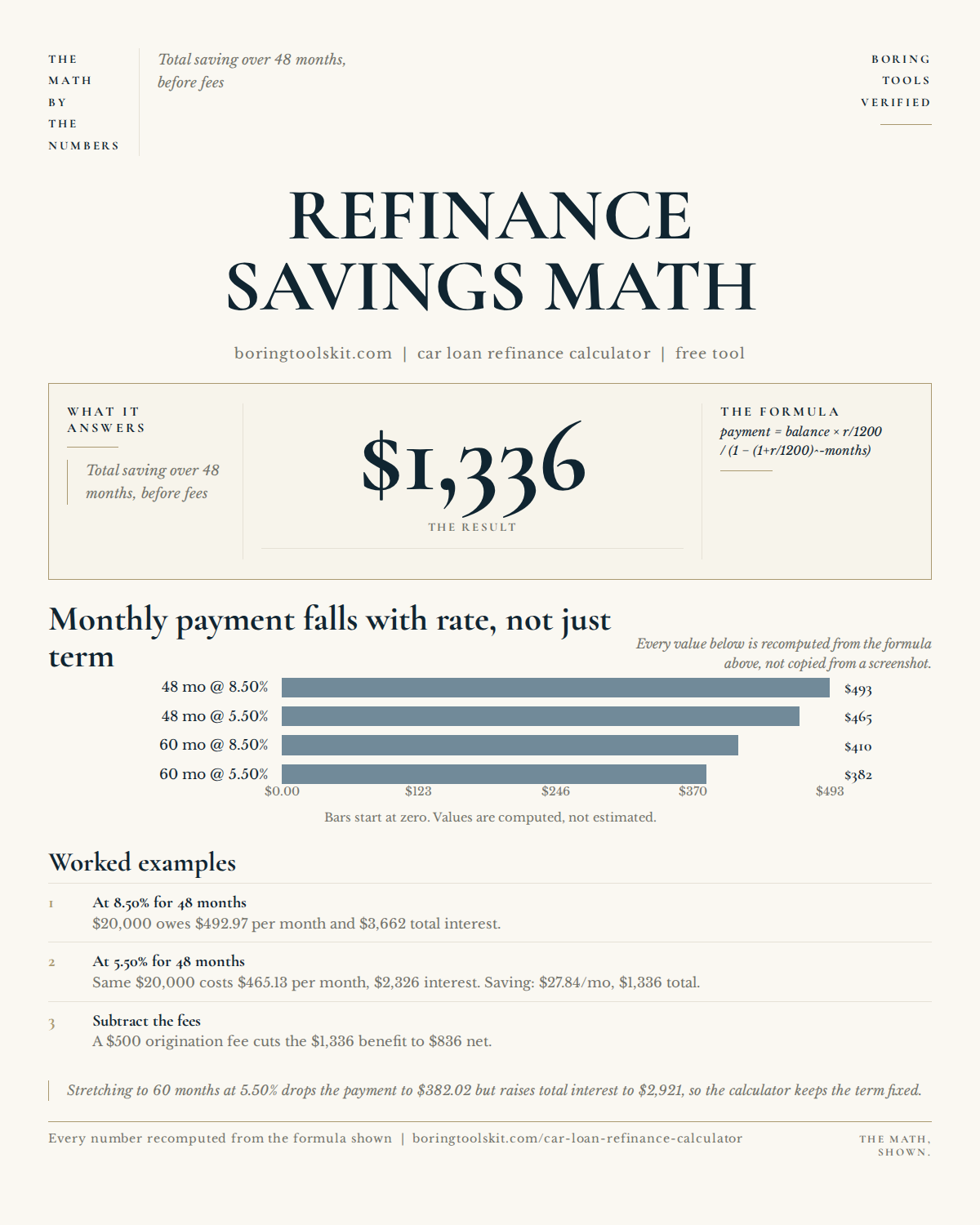
For balance B, annual interest rate i expressed as a percentage, and n monthly payments: payment = B * (i/1200) / (1 - (1 + i/1200)^(-n)). Monthly savings = old payment - new payment. Gross same-term savings = monthly savings * n. Manual fee adjustment: net savings = gross savings - upfront fees; simple payment break-even months = upfront fees / positive monthly savings. Use unrounded payments for these calculations.
Worked example
Hypothetical same-term inputs: balance $20,000, old interest rate 7.5%, new interest rate 5%, remaining term 48 months. The shipped payment formula returns old payment $483.58, new payment $460.59, monthly savings $22.99, and gross savings $1,103.62 before fees. A separately assumed $300 upfront fee leaves $803.62 of full-term savings and a simple payment break-even of 13.05 months, reached after the 14th monthly saving. The $300 fee is an illustration, not a tool default or lender quote.
Assumptions to verify
- Both loans amortize the same principal over the same remaining monthly term at fixed positive interest rates, with scheduled payments and no extra principal payments.
- Closing costs, title fees, and prepayment penalties are excluded from the compute core. Example fees are hypothetical cash payments, not lender quotes or coded defaults.
- There is no term reset in the modeled comparison. A longer replacement term needs its own repayment schedule.
- No cash-out, financed closing costs, balloon payment, or optional product balance is modeled.
- No mortgage-style escrow changes are modeled; vehicle insurance and other non-loan costs must be checked separately.
- Payments use monthly amortization rather than a lender-specific daily interest and payoff-date calculation.
Frequently asked questions
When does refinancing a car loan make sense?
It can make sense when the lower rate produces enough remaining payment savings to exceed fees and the replacement term fits your plans. Check the simple payment break-even rule and total remaining cost. The tool estimates the rate-only saving at the same balance and term, not an all-in recommendation.
Does this calculator include closing costs or a fee default?
No. The shipped formula contains no closing-cost input or assumed fee percentage. Subtract actual cash fees separately. The $300 fee used in the worked examples is explicitly hypothetical and is not a default. Financed fees require a comparison with different balances that this tool does not support.
Can I compare a longer replacement loan here?
Not directly. There is only one months field, shared by the old and new loan. Compare the actual schedules separately when terms differ. A longer payoff period can lower the monthly payment without lowering total remaining cost.
How is refinance break-even calculated?
For positive monthly savings and upfront cash fees, divide fees by monthly savings. This manual simple payment break-even is not built into the result. It excludes time value of money and differences in outstanding principal, so an early sale needs a payoff-balance comparison too.
Should I enter the interest rate or APR?
Use the contractual annual interest rate to estimate the amortizing payment. CFPB explains that APR includes certain borrowing fees while the interest rate does not. Compare disclosed APRs separately and avoid counting the same fee twice.
Can the calculator handle cash-out, zero rates, or equal rates?
No. Cash-out is not an input, and the current formula requires both rates to be positive and the new rate to be below the old rate. A rejected comparison does not determine whether a lender can offer that loan; it reflects the limits of this rate-reduction tool.
Cite this tool
BoringToolsKit. “Car Loan Refinance Calculator.” boringtoolskit.com/car-loan-refinance-calculator/ (reviewed October 2026). Free to reference in articles, syllabi, and answer posts with a link.
Privacy: Inputs and results stay in this browser. Any future sponsored recommendation or advertisement will be clearly labeled and kept separate from the calculation.