Updates automatically as you type.
Calculated in your browser; your inputs are not sent to us. Privacy
General estimate for planning only — not medical advice. Consult a doctor about your specific situation.
Calculation details
Review the generated output before relying on it.
This tool runs in your browser. Your calculator inputs and results are never transmitted to us or to ad/affiliate partners. Ads and sponsored links may set third-party cookies to serve and measure them, but they never receive your calculation values. If you explicitly save a scenario, its permitted fields stay in local browser storage until you clear them. See our Privacy Policy.
Use this result
Share the current inputs or ask ChatGPT to explain the calculation in context.
More options
What does this calculator estimate?
A GFR calculator estimates how well your kidneys filter blood, expressed in mL/min/1.73 m2. This calculator uses the 2021 CKD-EPI creatinine equation, the current US standard: it combines serum creatinine, age, and sex into an estimated glomerular filtration rate without requiring a race coefficient. Enter your serum creatinine (mg/dL), age in years, and sex to get an eGFR value you can compare against the chronic kidney disease stage bands. This is a screening estimate, not a diagnosis. (Source: BoringToolsKit GFR calculator)
- CKD-EPI 2021 creatinine equation: eGFR = 142 x min(Scr/k, 1)^alpha x max(Scr/k, 1)^-1.200 x 0.9938^age x 1.012 if female, where k = 0.7 for females and 0.9 for males, and alpha = -0.241 for females and -0.302 for males. (Source: NIDDK, CKD-EPI creatinine equation 2021)
- The 2021 refit removed the race coefficient that the 2009 equation applied, after studies showed race is a poor proxy for the muscle mass the equation is really correcting for. (Source: NIDDK, 2021 CKD-EPI equation announcement)
- A result at or above 60 mL/min/1.73 m2 is generally considered adequate kidney filtration if there is no other marker of kidney damage; values are interpreted alongside urine albumin and clinical history, never on their own. (Source: National Kidney Foundation, KDIGO staging)
- Serum creatinine is sensitive to muscle mass, so the same creatinine value means something different for a 120 lb 70-year-old than a 220 lb 30-year-old, which is exactly why age and sex are equation inputs. (Source: BoringToolsKit calculation methodology)
- Cystatin C based eGFR is an alternative when creatinine is unreliable (extreme muscle mass, unusual diets); this calculator does not run that equation. (Source: NIDDK, CKD-EPI cystatin C equations)
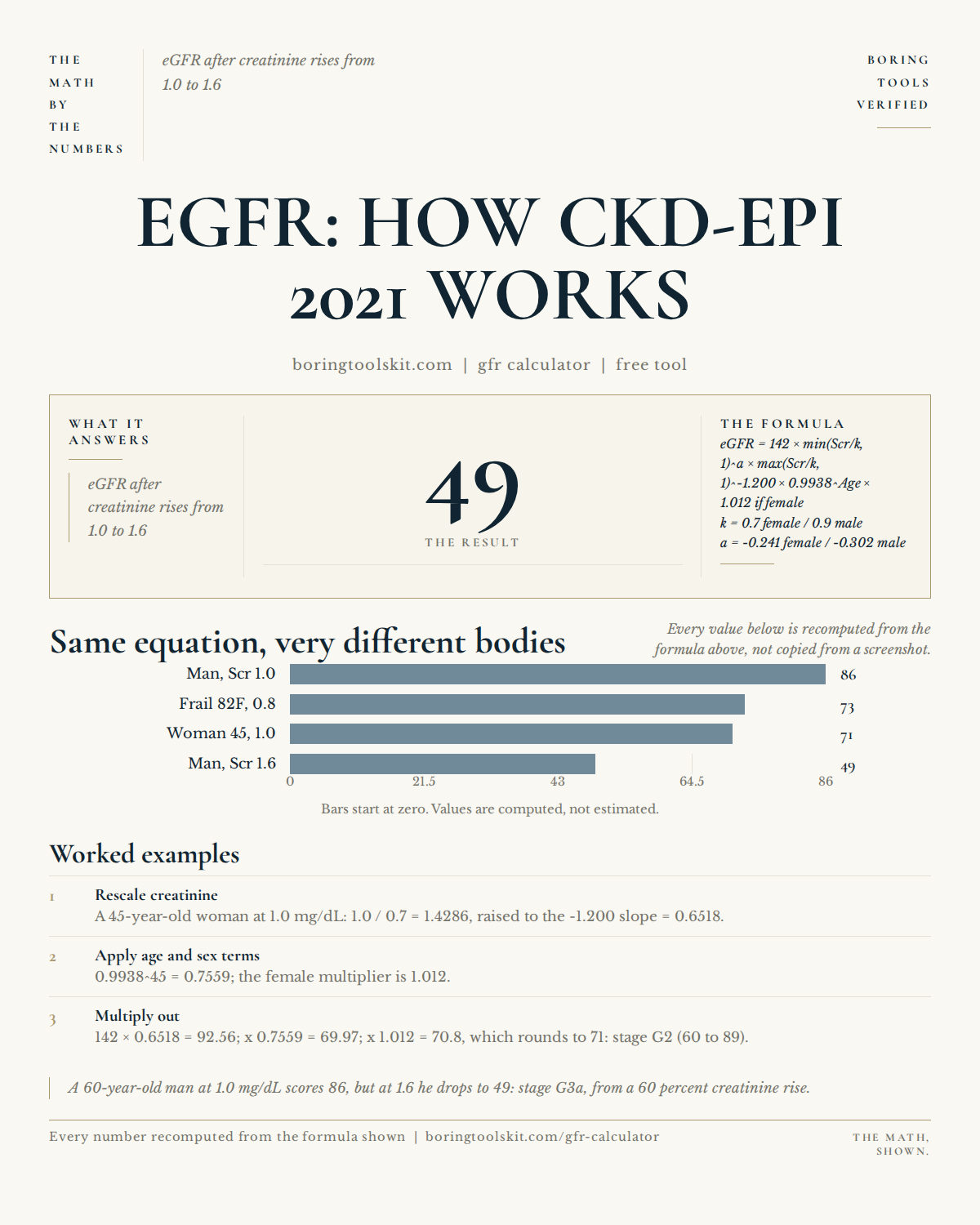
What the CKD-EPI 2021 equation does
The equation converts a single creatinine blood value into an estimated filtration rate. It is built from a two-part power function: below the threshold k, creatinine rises slower than filtration falls, so the min() term uses one exponent; above k, the max() term uses a gentler -1.200 exponent. Age enters multiplicatively as 0.9938 raised to your age, so filtration drops roughly 6% per decade of life at a constant creatinine, and the female multiplier 1.012 corrects for average muscle-mass differences.
Worked example: a 55-year-old male with serum creatinine 1.2 mg/dL. k = 0.9, so Scr/k = 1.333, min = 1, max = 1.333. eGFR = 142 x 1 x 1.333^-1.200 x 0.9938^55 x 1 = 71 mL/min/1.73 m2, which falls in the normal-range band.
Reading the result against CKD stages
The standard bands are: 90 or above (G1, normal or high), 60 to 89 (G2, mildly decreased), 45 to 59 (G3a), 30 to 44 (G3b), 15 to 29 (G4, severely decreased), and below 15 (G5, kidney failure). A single value in G2 without other markers of kidney damage is not chronic kidney disease by itself; diagnosis requires the reduced filtration to persist across time or an albuminuria marker.
For the borderline 45 to 59 band especially, repeat testing and a urine albumin-to-creatinine ratio matter more than the single number this calculator produces.
When this estimate is unreliable
The creatinine-based estimate assumes typical muscle mass for your age and sex. Bodybuilders, amputees, people with severe malnutrition or neuromuscular disease, pregnant people, and those on dialysis all fall outside the equation's training population. Acute kidney injury invalidates it entirely: eGFR equations assume a steady-state creatinine, and a value that changed within days is not steady state.
If any of those apply, ask about a cystatin C test, which is far less dependent on muscle mass.
How this calculator works
Formula
CKD-EPI 2021: eGFR = 142 x min(Scr/k, 1)^alpha x max(Scr/k, 1)^-1.200 x 0.9938^age x 1.012 if female, with k = 0.7 (female) / 0.9 (male) and alpha = -0.241 (female) / -0.302 (male); result in mL/min/1.73 m2.
Worked example
55-year-old male, serum creatinine 1.2 mg/dL: Scr/k = 1.333, so eGFR = 142 x 1.333^-1.200 x 0.9938^55 = 71 mL/min/1.73 m2 (G2 band, normal-range if no other kidney-damage markers).
Assumptions to verify
- Steady-state serum creatinine: the value has been stable, not changing rapidly within days.
- Adult 18 or older; the equation was fit and validated on adult populations.
- Typical muscle mass for age and sex; extremes shift the estimate without reflecting true kidney function.
- Result is an estimate in mL/min/1.73 m2 and is not a diagnosis; discuss abnormal results with a clinician.
Frequently asked questions
What is a normal GFR for my age?
A value of 60 mL/min/1.73 m2 or higher is generally considered adequate filtration, and 90 or above is normal. It declines with age, so a healthy 80-year-old may sit in the 60 to 89 band without kidney disease.
Which equation does this GFR calculator use?
The 2021 CKD-EPI creatinine equation (race-free), the standard recommended across US laboratories: eGFR = 142 x min(Scr/k, 1)^alpha x max(Scr/k, 1)^-1.200 x 0.9938^age, times 1.012 for females.
Is an eGFR of 55 serious?
It falls in stage G3a (moderately decreased). On its own it is not a diagnosis; persistence on repeat testing and an albuminuria result determine whether chronic kidney disease is present. See a clinician rather than acting on a single estimate.
Why is age an input to a GFR calculation?
The equation was fit on populations where filtration declines with age at a constant creatinine, so age is a required correction: 0.9938^age multiplies the result, about -6% per decade.
Does race matter in this calculator?
No. The 2021 CKD-EPI equation intentionally removed the race coefficient used in the 2009 version.
Cite this tool
BoringToolsKit. “GFR Calculator.” boringtoolskit.com/gfr-calculator/ (reviewed October 2026). Free to reference in articles, syllabi, and answer posts with a link.
Privacy: Inputs and results stay in this browser. Any future sponsored recommendation or advertisement will be clearly labeled and kept separate from the calculation.