Updates automatically as you type.
Calculated in your browser; your inputs are not sent to us. Privacy
Calculation details
Review the generated output before relying on it.
This tool runs in your browser. Your calculator inputs and results are never transmitted to us or to ad/affiliate partners. Ads and sponsored links may set third-party cookies to serve and measure them, but they never receive your calculation values. If you explicitly save a scenario, its permitted fields stay in local browser storage until you clear them. See our Privacy Policy.
Use this result
Share the current inputs or ask ChatGPT to explain the calculation in context.
More options
What does this calculator estimate?
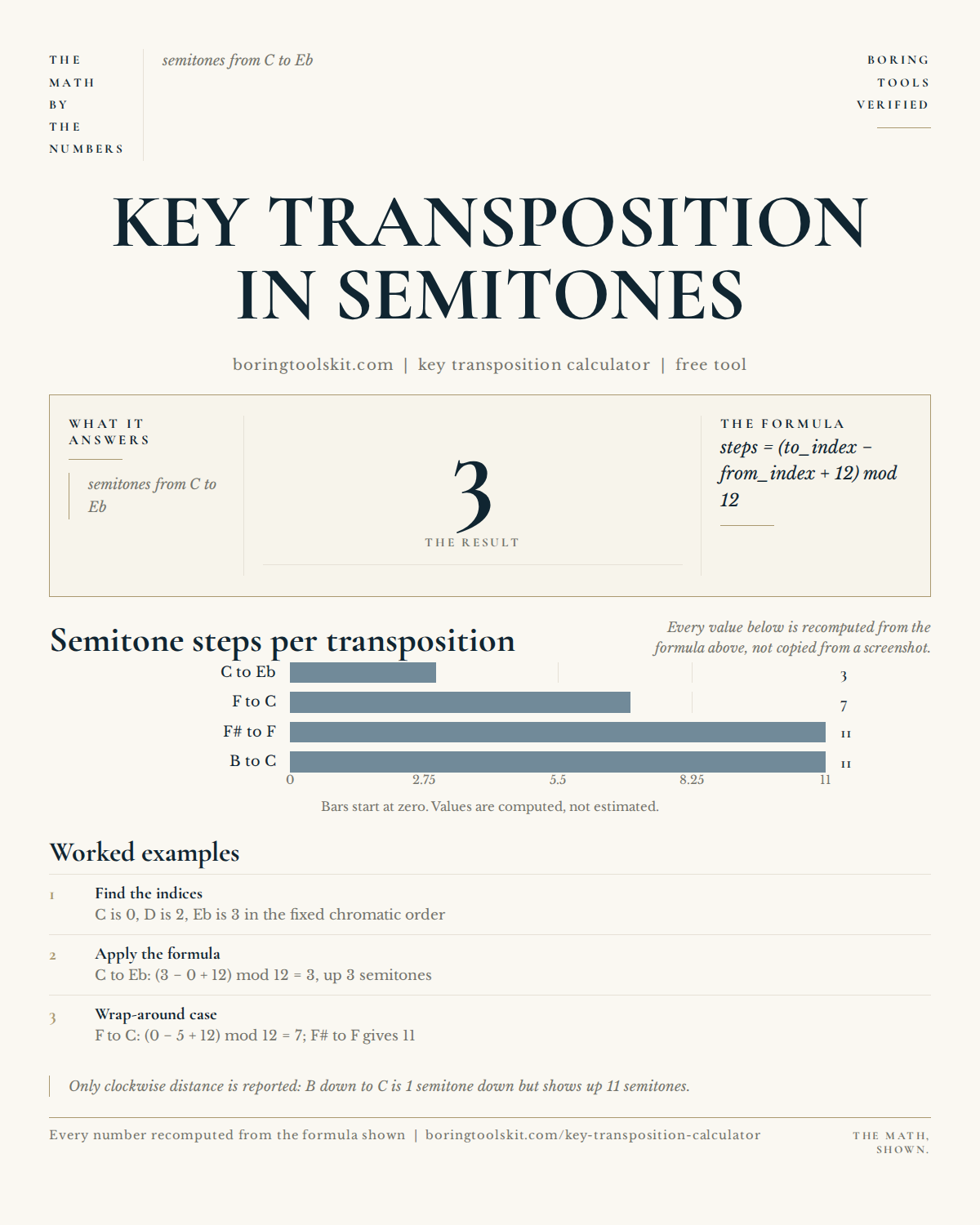
Transposing a key means shifting every note by the same number of semitones: C to G is up 7 semitones, C to Eb is up 3, and Eb back to C is up 9. The shift wraps around the 12-note chromatic scale, so the answer is (target - original + 12) mod 12, and every note keeps its scale degree in the new key.
- Transpose distance = (target key position - original key position + 12) mod 12 on the chromatic scale (Source: BoringToolsKit methodology)
- C to G is up 7 semitones, and C to Eb is up 3 semitones (Source: BoringToolsKit methodology)
- Shifting 12 semitones returns a key to the same pitch class, so all 12 transpositions of a key cover every major key exactly once (Source: BoringToolsKit methodology)
How this calculator works
Formula
semitones = (position(to) - position(from) + 12) mod 12. Example: position(C) = 0, position(G) = 7, so C to G is up 7 semitones; Eb to C is (0 - 3 + 12) mod 12 = 9.
Worked example
C to G: 7 semitones. C to Eb: 3 semitones. Eb to C: 9 semitones. C to C: 0, no change (same key). Every melody in C sounds the same, 7 semitones higher (a perfect fifth), in G.
Assumptions to verify
- Keys are compared on the 12-note chromatic scale with enharmonic equivalents treated as one position
- The result is the upward shift; transposing down is 12 minus the result
Frequently asked questions
How many semitones is C to G?
Seven. G is 7 chromatic steps above C, the interval called a perfect fifth.
Does transposing change the melody?
No. Every interval between notes is preserved; the whole melody shifts to a new register while staying musically identical.
Why transpose a song at all?
To fit a singer's range, match an instrument's key, or simplify the chords. The pitch moves; the musical structure does not.
Cite this tool
BoringToolsKit. “Key Transposition Calculator.” boringtoolskit.com/key-transposition-calculator/. Free to reference in articles, syllabi, and answer posts with a link.
Privacy: Inputs and results stay in this browser. Any future sponsored recommendation or advertisement will be clearly labeled and kept separate from the calculation.